

Development Communication had its roots in agricultural journalism and agricultural communication. In 1968, when the Philippines was undergoing economic, social, and political crisis, a small slice of communication professionals began to be concerned with communication for agricultural development. With most of our communication practitioners practically saturating the urbanized, metropolitan of our society, a lot of our agricultural rural populace were left in a vacuum, unaware of the developments and advances in our society, hence, remaining underdeveloped.
Two groups, namely the Philippine Press Institute and Press Foundation of Asia gave form to the reporting of news on development called Development Journalism. In 1973, the College of Agriculture in U.P. Los Baños renamed its agricultural communication program to Development Communication, thus starting a new undergraduate program. Other agricultural colleges and universities in the Philippines and in Asia then followed after they found it appropriate for their mission. Xavier University was one of them, whose vision for students – “to become men and women for others” – aptly fits into the philosophy of development communication.
RCC and FSOA
In Xavier University, the application of Development Communication which was conceived not only to provide information needed in rural Northern Mindanao, but to effect the necessary attitudinal change to farmers who said NO to development and agricultural technology, started with the Rural Communication Center (RCC) of the XU College of Agriculture Complex. The RCC equipment was sourced by Rev. Fr. James Reuter, S.J. and donated by the Carmelite Fathers Communication Bureau. Since the College of Agriculture Extension Program was one of the Units of the Aggie Complex, RCC cashed in on the popularity of the Visayan Radio Drama, producing success stories of local farmers applying new technologies. RCC also coordinated with XUCA Institute of Market Analysis to air over DXCC daily prices of farm products in Cagayan de Oro.
Encouraged by the success of the RCC Visayan Radio Drama as an Aggie Extension tool and support, it later conceptualized a more structured educational program using the synergy of the Philippine Government Aggie Staff and the XUCA Aggie Faculty to produce the Farmers’ School-on-the-Air (FSOA) and provide RCC with its faculty. It also made arrangements with participating rural banks to provide and facilitate credit to its graduates. The modules were on specific crops and animal production and qualified farmers received certificates during completion ceremonies in Xavier University. Some of the courses included beef cattle production, animal nutrition, agronomy and specific crops, agribusiness, and marketing. Those who passed the Beef Cattle Production and Piggery courses qualified for the government’s Animal Dispersal Program.
In the Farmers’ SOA, the RCC worked with parish priests, whose parishes served as drop-off centers for notes which students would study. The farmer-students would then take a test administered by the FSOA anchor on air. The students would send their answers either to the parish or directly to the station. The program ran from 5:30AM – 6:00AM. The status of farmers greatly improved because of this effort.
When visuals or actual field demonstrations were needed, student-farmers from three (3) outlying municipalities met in a central municipality with the FSOA faculty conducting the lecture- demo. The whole-day activity was a time for fellowship and learning in an atmosphere of sharing and picnic camaraderie. The success of the Farmers’ School-on-the-Air prompted the East-West Center of the University of Hawaii to invite the RCC Director to its Summer Inter-Nation Conference on Non-Formal Education to deliver a Paper on Development Communication In the Philippines. Soon after, other Southeast Asian countries like Indonesia and Malaysia established its own Distance Learning Programs for development.
Development of the DevCom Curriculum
Rev. Fr. William F. Masterson, S.J., Founder and Director of the Xavier University College of Agriculture Complex saw the effectiveness of RCC as a development and aggie extension tool. Mrs. Corazon G. Calub who organized RCC and became its first director was then sent to Ateneo de Manila University to pursue a Master’s Degree in Communication Arts. The knowledge she acquired and her close association with colleagues in UPCA, Los Baños, and the Philippine Association of Communication Educators allowed her to develop the curriculum for DevCom in XU. The challenge then was, “How do you effect change in farmers who say NO to development and new technologies in agriculture?” The DevCom program built its strength in the use of the cultural medium with communication students immersing in rural and cultural communities doing listening activities and documenting communication patterns of rural/tribal communities which would soon become Aggie Extension Service Areas.
DevCom in XUCA… and ArtScies

DevCom was introduced in XU College of Agriculture in 1978. Later, it was offered by two colleges – the College of Arts and the College of Agriculture. The College of Arts offered it as AB Major in DevCom. The College of Agriculture offered it as BS Agriculture Major in DevCom.
There were three major activities in DevCom:
- Instruction
– takes care of instruction of all BSDC and DevCom majors in the College of Agriculture and College of Arts and Sciences following the curricula for both major types
– coordinates with the Rural Communication Center in providing the students with laboratory facilities for courses in broadcasting and audiovisual production
- Research
– coordinates with RCC in conducting researches relevant to DevCom
– undertakes researches in consortium with other government and private agencies
- Extension
– trains rural leaders on formal and non-formal courses in development communication and rural development
– coordinates with XU Extension Service in conducting trainings as well as in disseminating useful and relevant developments/agricultural information
– information dissemination to various rural and urban clientele through radio broadcasts, print, and audiovisual channels.
The simultaneous offering came under review around 1989. The following challenges were met:
- Marrying the two existing majors in DC to one, full, four -year program
- Improving facilities, equipment, and materials
- Getting full- time, competent teachers
- Increasing BSA in DC enrolment to qualify it being offered as BSDC
- Getting CHED approval of the BSDC Course
- Getting the AB Major in DC to be phased out, or for the College of Arts and Sciences to stop its offering, which eventually happened in 1994.
A committee, composed of the Chair of BSDC, and the Deans and Associate Deans of both colleges reviewed curricula and considered the phase-out of the offering of AB Major in DevCom in the College of Arts. The process was long, starting out from an academic and technical review of both curricula and courses, to review graduates, their market and performance, and enrolment trend. It also conducted an alumni survey. It took about four years – from 1991 to 1994 – before the phase-out was finally decided. The BSDC then had already been operational as a full, four- year program, as it was already recognized by CHED in 1986 with only one major offered – Journalism. Educational Communication (EduCom) was offered sometime in 1994.
Back then, DevCom was focused on communication for development of agricultural communities, banking on the program’s strength on group dynamics, social psychology, and radio dramas. Students are then to choose their major on their 3rd year in the program between as Development Journalism and Educational Communication.
From specialists to generalists
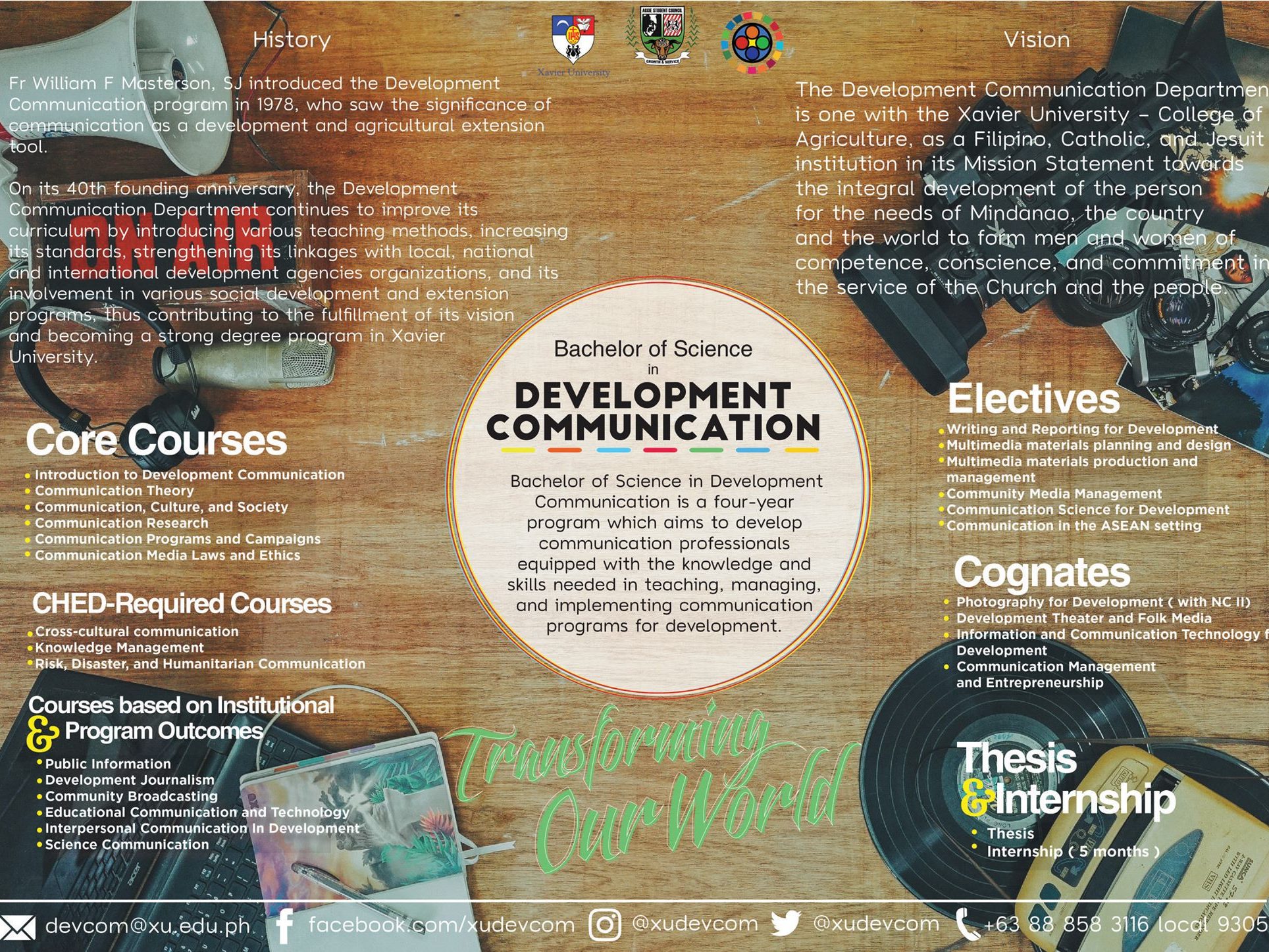
Since the early 1990’s, DevCom students are classified into two – Dev Journ and EduCom specialists. Starting school year 2013-2014 however, the program shifted from forming development communication specialists to generalists as it decided to remove the two specialized tracks for its students. This, after considering current trends and demands in the field.
Today, the Development Communication Department continues its efforts to improve its curriculum by introducing various teaching methods, increasing its standards, linking with outside organizations, and its involvement in various extension programs. This, to achieve its vision of transforming the world through communication for development; in line with the university’s vision to be a leading ASEAN university forming men and women of characters.



 Xavier Ateneo DevCom Department
Leave a comment