
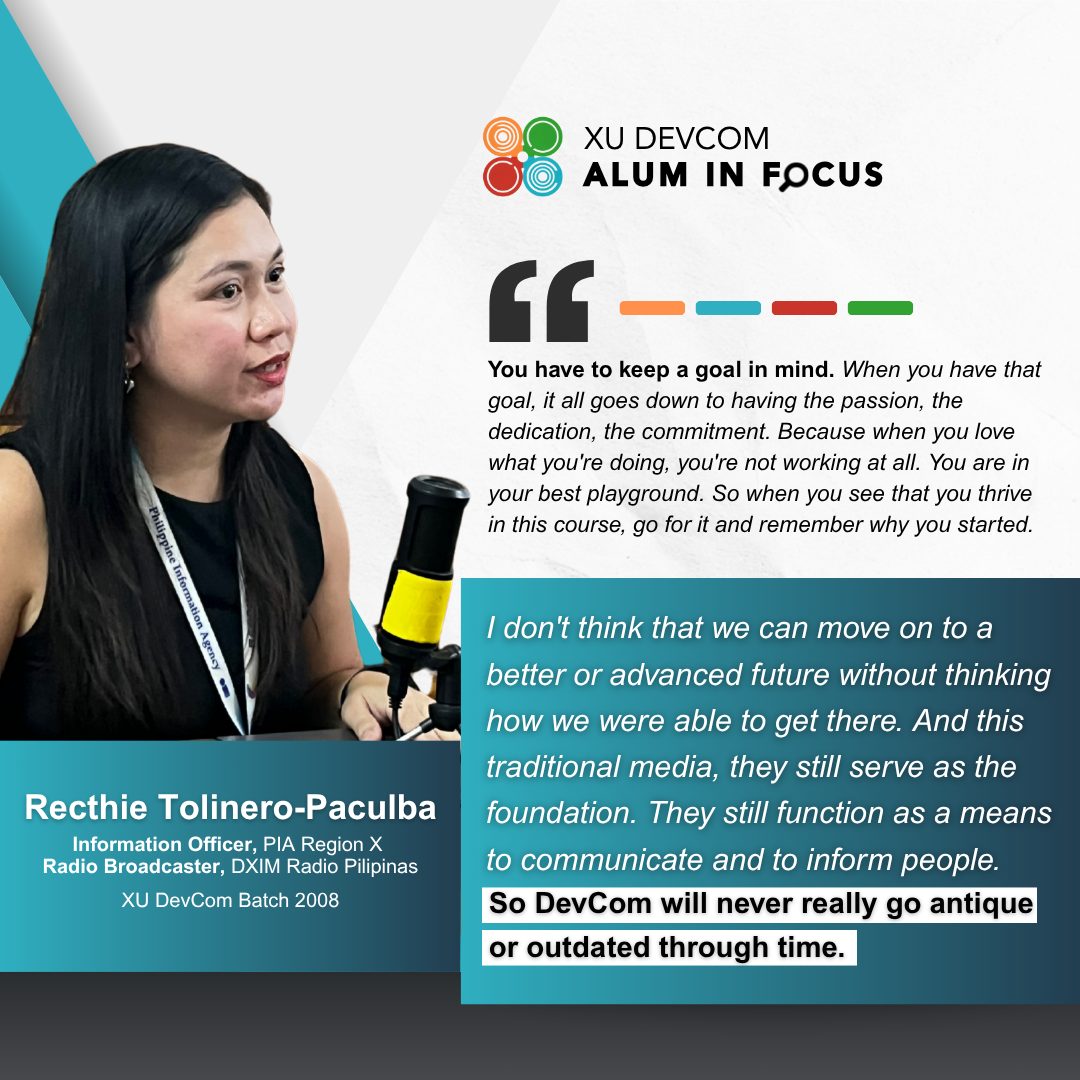
ON AIR and IN ACTION
“We don’t settle for less because we can always be more in what we are currently doing right now or what we are pursuing. So, we don’t settle for less. That’s the DevCom way.”
Recthie Tolinero-Paculba, a graduate of XU Development Communication, sees her course not merely as an academic program, but as the foundation that shaped her personal and professional identity. Her varied interests—photography, writing, and broadcasting—come together to make her career dynamic and deeply meaningful.
Journey & Beginnings
Recthie’s story begins back in high school, where she first discovered the power of words. As a member of her school’s campus paper, she competed in Feature Writing (Filipino), which sparked her early love for communication. While many of her peers aspired to enter STEM fields, Recthie was drawn to a path that merged creativity with social relevance. That path led her to Development Communication.
Fueled by her passion and supported by scholarship opportunities, she enrolled at Xavier University, confident that the field would bring her both fulfillment and a sense of purpose.
“I somehow brand myself as an introvert…”
Though she doesn’t enjoy face-to-face conversations with large groups, radio felt like a more natural fit. Speaking through a microphone gave her a bridge to reach others without the pressures of being physically present. Over time, one guiding principle became central to her journey: Magis—the call to do more, be more, and serve more.
She acknowledges that challenges are inevitable, but emphasizes the importance of resilience, focus, and creativity—carried out with grace and passion. Through that mindset, she learned to find joy and meaning in every task.
Living the DevCom way
Today, Recthie serves as an Information Officer for the Philippine Information Agency–Region 10 and also hosts a radio broadcast aired on DXIM Radyo Pilipinas in Cagayan de Oro. Her current career is a living reflection of the principles and skills she developed at Xavier University.
“It played a big part in my life.” She firmly believes she wouldn’t be where she is now if it weren’t for her chosen program. “I don’t think that I can be an effective communicator without the foundations of DevCom.”
From the very first day, she was grounded in communication theory, creativity, and real-world applications. Although she considers herself part of the older batches of DevCom students, she recognizes the field as ever-evolving—constantly adapting to technological changes.
“That’s the DevCom way.” For Recthie, being static is not an option. Communicators must evolve with their audiences, constantly adjusting their tools and strategies.
“Almost every day in my life,” she said when asked how DevCom principles show up in her work. “As a writer, as a broadcaster… We don’t just settle for what we see in the news, in the community, or in the events happening around us.”
As part of the community herself, she sees DevCom not just as a career, but as a commitment—to inform, to empower, and to act. Each story she writes and every message she broadcasts is a chance to spark awareness and inspire change.
“We can be a hero,” she affirms, “even if we are DevCom students.”
Values in Action
One of Recthie’s greatest challenges is handling sensitive or complex topics in the media. “We can’t respond or suggest solutions without first arming ourselves with the right information,” she shared.
Her DevCom training taught her the importance of thorough research, fact verification, and hearing all sides of a story. Responsible communication, for her, means presenting facts clearly, listening with empathy, and avoiding emotional or biased responses.
“In DevCom, we’re trained to be the bigger person,” she added. “We seek ways to inform without causing unnecessary harm. That’s the kind of discipline that has guided me through even the most difficult broadcasts.”
In today’s digital media landscape—where misinformation spreads quickly—maintaining credibility is more crucial than ever. DevCom plays a key role in navigating this fast-paced, often misleading environment.
“As a DevCom graduate, you’re trained to look deeper—to ask, ‘Where is this coming from? Is this credible? Can this be verified?’”
She sees this not just as a skill, but as a moral obligation. Whether it’s using fact-checking tools or applying foundational principles of media literacy, her commitment to truth and ethical storytelling remains unwavering.
Looking Forward
With Development Communication now under the College of Arts and Sciences, Recthie shares a mix of nostalgia and anticipation.
“When I heard about it, I was somehow excited for the college,” she said. “But at the same time, I felt a bit nostalgic.”
For her, the department’s agricultural roots weren’t just symbolic—they were personal. She fondly recalls experiences like tumba baka, planting crops, hiking to remote communities, and forming a deep respect for rural life.
“Those are things the next generation of DevCom students might no longer experience,” she reflected. “The dust, the mud, and everything about agriculture—I’m missing those experiences already.”
Despite this shift, she remains hopeful. She believes this transition will allow the program to reach more students passionate about communication, broadening the impact of DevCom and encouraging future practitioners to become agents of change in their own right.
In every community she connects with, every story she amplifies, and every challenge she faces, Recthie Paculba exemplifies what it means to be a DevCom practitioner. Her career stands as proof that Development Communication is not limited by classrooms, mediums, or even time periods.
It lives in values—how one observes, listens, and acts upon the issues of society. The dust may settle on old paths, and departments may change, but the DevCom spirit remains steadfast: rooted in truth, driven by purpose, and always striving for more.
Because for Recthie—and for every DevCom student who walks a similar path—settling for less was never an option. It never will be.



 Xavier Ateneo DevCom Department
Leave a comment